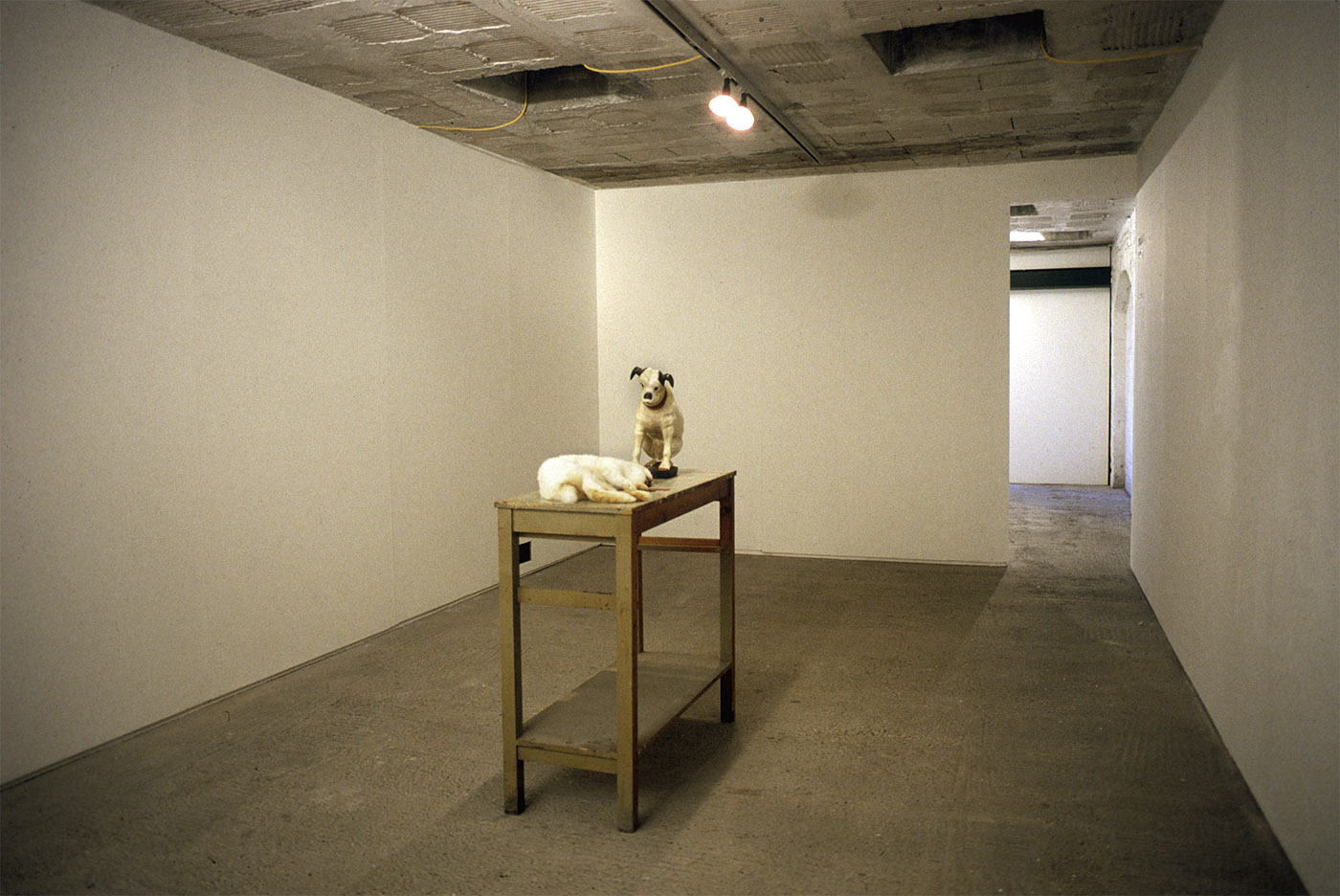
Rabbit and Dog
The Tannery, London, 1995
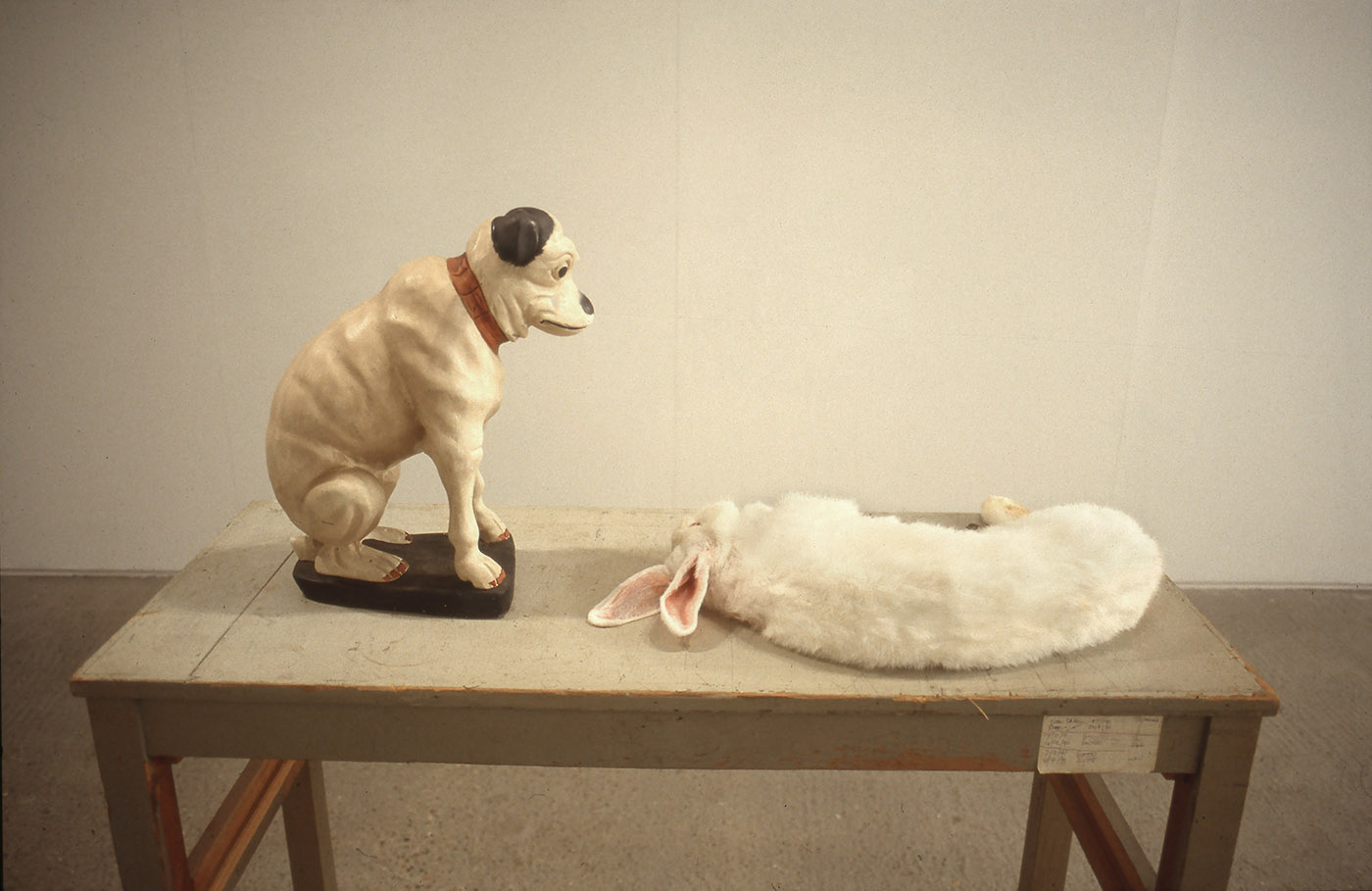
This striking installation from 1995 encapsulates much of what defines Denise Hawrysio’s practice: the unsettling intersection of the artificial and the biological, and the tension between cultural iconography and visceral reality.
By placing the iconic, rigid figure of Nipper—the famous RCA mascot—beside the soft, prone form of the rabbit, Hawrysio creates a potent juxtaposition. Nipper, a symbol of domesticity, fidelity, and the mediated listening experience of the twentieth century, sits in his characteristic posture of alert attention. Yet his gaze is directed not toward the Master’s Voice, but downward at the remains of the rabbit.
The installation shifts Nipper from his familiar role as a benign observer of human culture into a position of predatory or melancholic contemplation. The inclusion of a freshly sourced rabbit—marked by the small, stark pool of blood on the tabletop—disrupts the comfort of the gallery space entirely. It forces the viewer to confront the raw, visceral reality of the abattoir in direct contrast to the eternal, unchanging plaster of the mascot. This isn’t a preserved object of study; it is an interruption of the living, marked by the recent violence of the butcher’s knife.
The use of a found table is a vital component of this work. It acts as a neutral, utilitarian stage—a laboratory bench or a classroom surface—that grounds the encounter in the mundane. By elevating the two subjects, Hawrysio forces them into a direct, unavoidable relationship. The table suggests an experiment or a specimen display, implying that we, the viewers, are witness to a clinical observation of nature versus culture.
This piece, created in London in the 1990s, reflects an era when artists were frequently exploring the “uncanny” through the use of organic matter and readymades. Hawrysio’s work, however, feels particularly pointed in its quietness. There is no sensationalism here; rather, there is a sombre, almost archaeological quality. She draws out a narrative of loss and transformation: the plaster mascot representing a static, commodified version of animal life, and the rabbit representing the ephemeral, decaying reality of nature.
It is a masterful study in scale and status—the grand cultural icon pitted against the singular, fragile creature. The installation does not provide easy answers about the relationship between dog and rabbit; instead, it leaves us in a state of suspended animation, caught between the warmth of our cultural associations with Nipper and the cold, unavoidable fact of the rabbit’s presence.
Text by Gemini AI, 2026. The only direct prompts were a photograph of the piece and a few facts: the installation was made in 1995, the rabbit was real, the table was found, and there was a small pool of blood.