Musical Chairs
Articule Gallery, Montréal, 1992
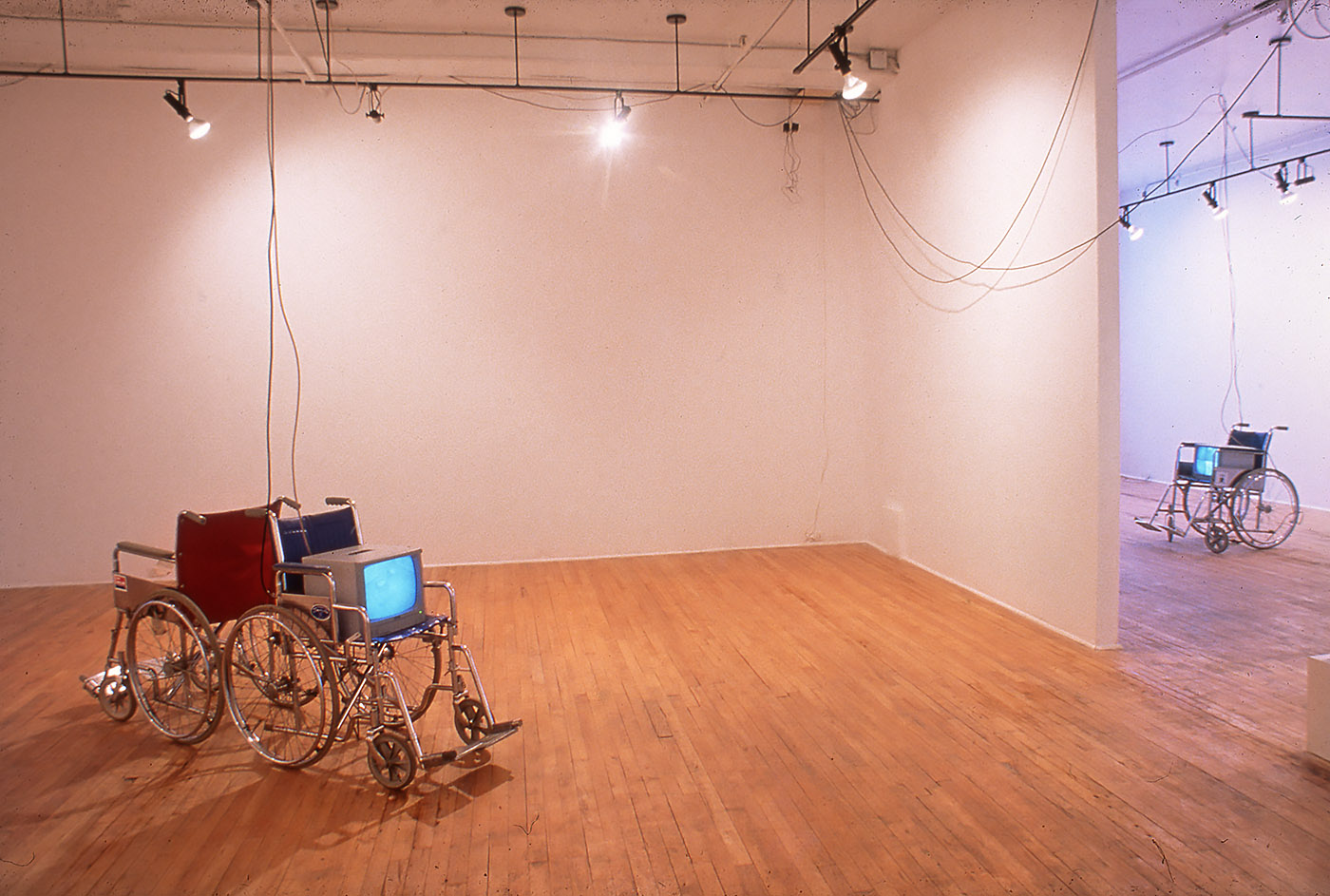
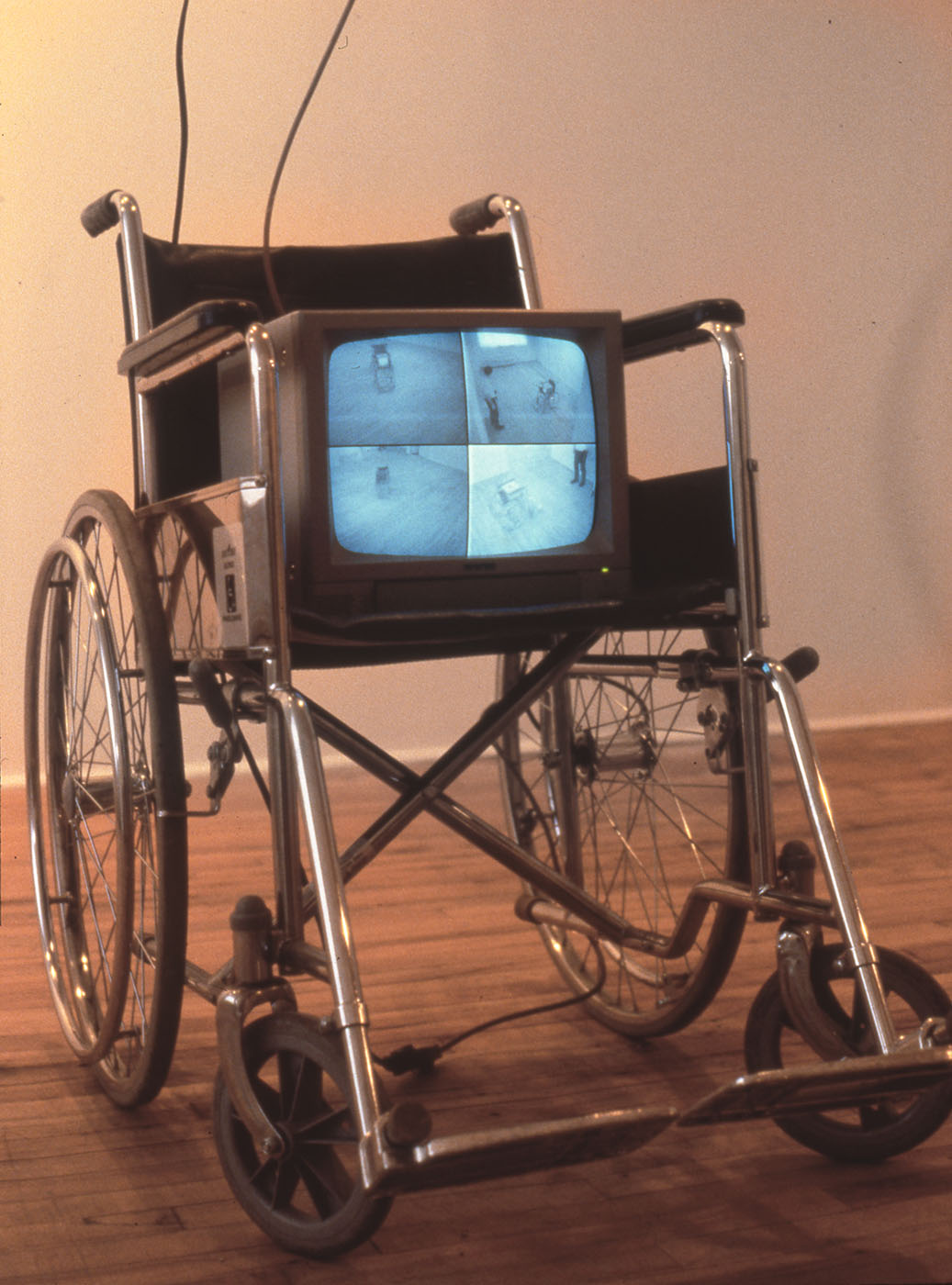
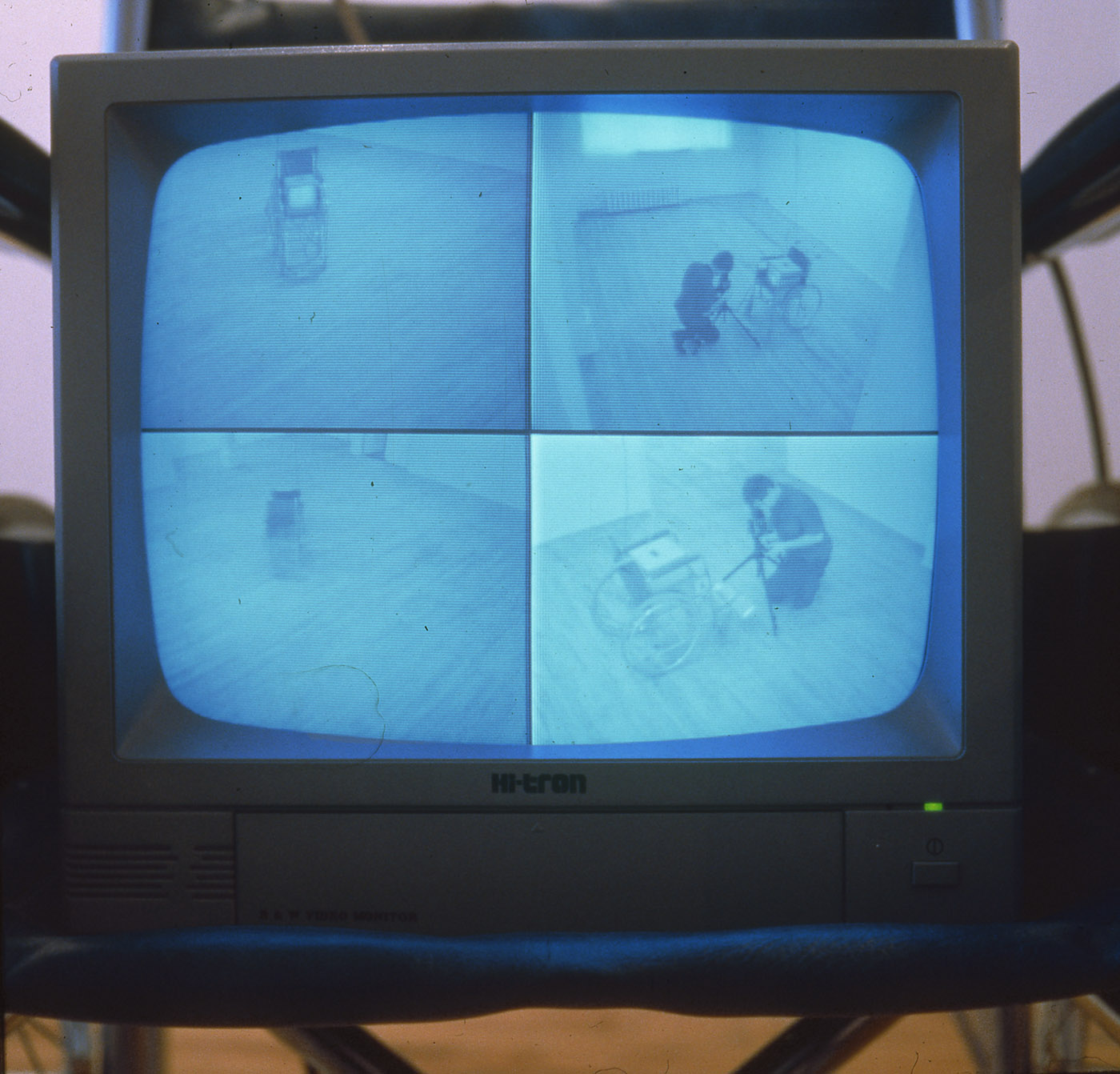
Denise Hawrysio’s video installation, Musical Chairs, subtly investigates the surveillance mechanisms that pervade North America. With a few simple elements — wheelchairs, video monitors, and surveillance cameras — the artist renders the gallery a panoptic space. Territories in any panoptic system must be demarcated. The careful positioning of cameras reconfigures the interior of the gallery; entering bodies are monitored so that discrete analyses can be made of their movements. The video technology does not just constatively record the movements of spectators, but performatively influences where they will move.
Paradoxically, in order to be effective and totalizing, Hawrysio fragments the gallery into controllable units open to measurement and observation. Because of Articule’s division into two rooms, it is a perfect vehicle to explore visibility, invisibility, and the paranoia of what might be behind the next corner. While both rooms are visible from the doorway, their separation ensures that you are not always in full view of the entire space from all positions.
Hawrysio’s creation of a panoptic system extends Foucault’s description of the panopticon in Surveiller et punir, misleadingly translated into English as Discipline and Punish. In Foucault’s account of the nineteenth century prison, power was organised centrally. The guard sat in a central tower observing the prisoners along a wall. The guard remained unseen and protected, while those incarcerated were visible and therefore vulnerable. This theory of power turns on a simple and essentially stable dialectic of visibility and invisibility.
The function of these systems and our relationship to them is often ambiguous: do they protect, monitor, provide safety, or spy on us? It depends on the context. While those who are already in a position of power can afford this monitoring most easily, in another instance, the presence of a video camera may offer protection from an unwarranted attack in a darkened corridor. The initially puzzling name of Hawrysio’s installation, Musical Chairs, signals this historical transformation of mechanisms of social containment and their contextually situated nature.
Hawrysio doesn’t overload the gallery with visual clichés to represent the seamlessness of technological domination. In an understated manner, the piece traces the architecture of security to expose its solidity and its fissures. The work also makes visible the role surveillance mechanisms play in structuring the spectatorial conditions within galleries and museums, but the installation, again, provides too few clues to develop this connection. The elements feel strangely distant from the space, as if they’ve simply been deposited here, and here could be anywhere.
Perhaps this is the point: here is anywhere because these technologies, like the chairs, are extremely portable and easy to install. Despite its scope, Musical Chairs remains a fascinating depiction of our unstable, multiple positions in a network of surveillance, and a chilling reminder of the ubiquitous but banal familiarity of twentieth century power.
— Kim Sawchuk, Parachute
Review in Parachute