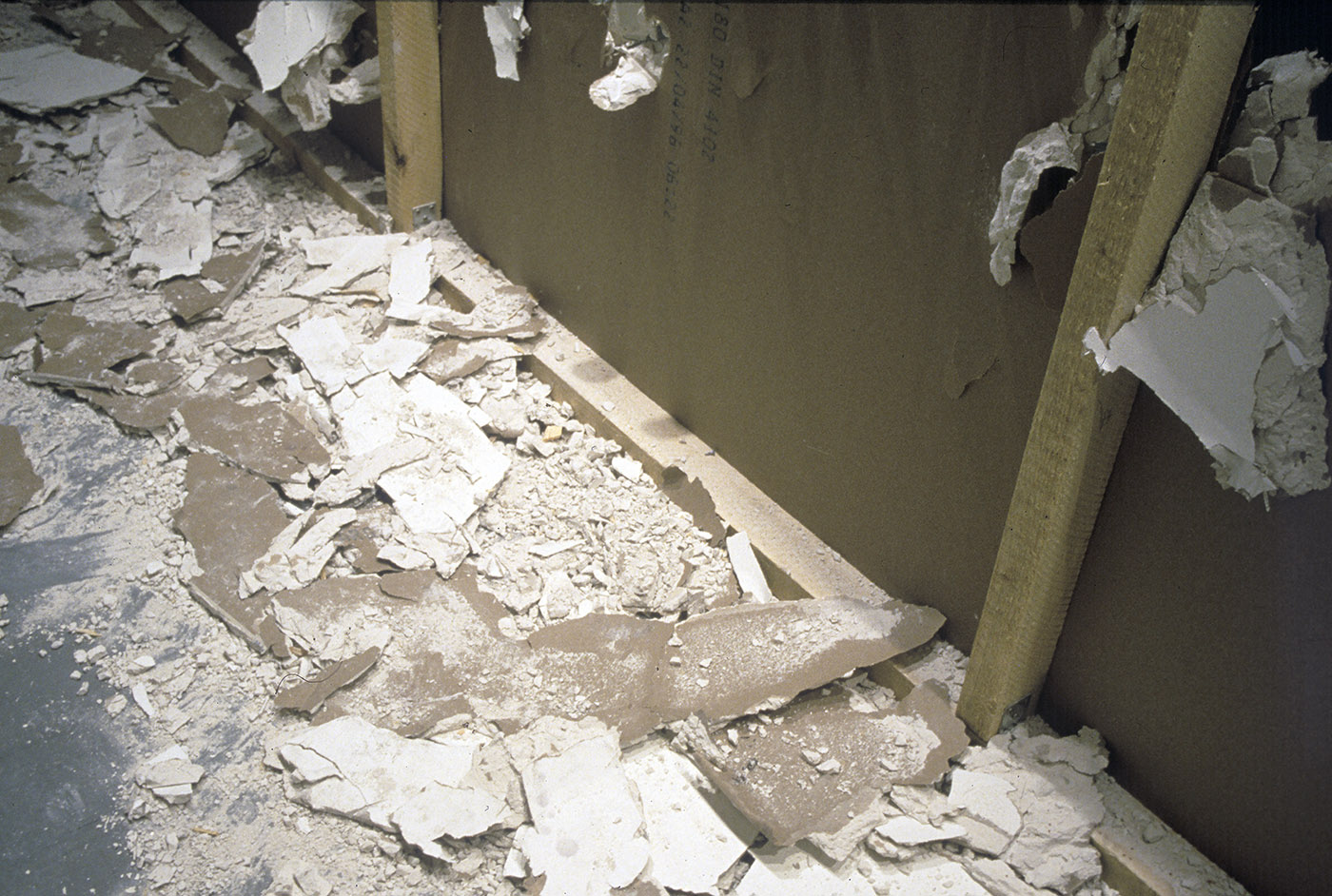
Family Stigmata
Plasterboard / wood / axe
Disneyland After Dark, Uppsala Konstmuseum, Sweden, 1995
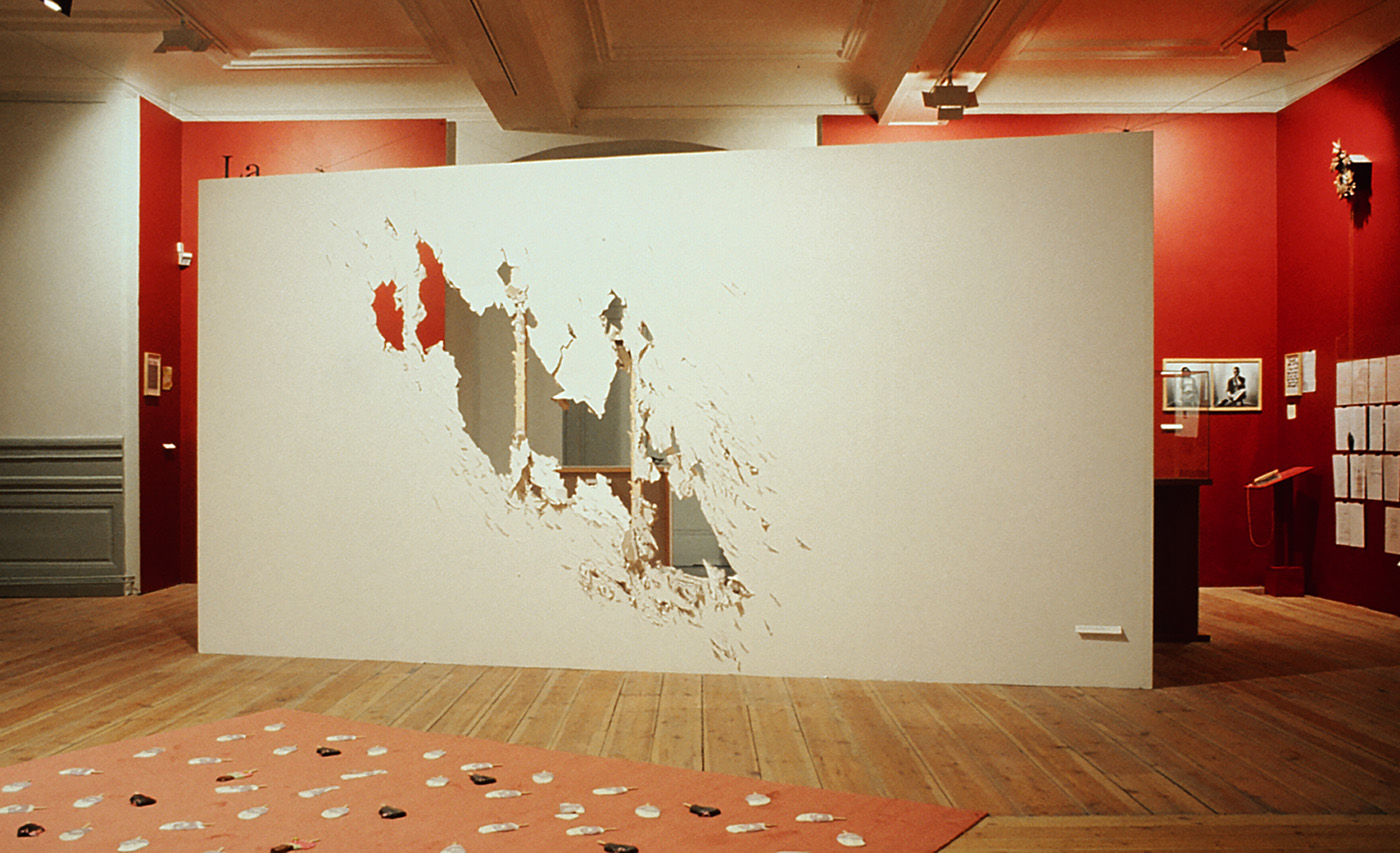
Family Stigmata and He Who Hesitates Is Lost belong to an evolving series of “slashed wall” installations created by Hawrysio between 1993 and 2004, starting with the exhibition 15/1 at her Malania Basarab Gallery in London. Developed for the touring group exhibition Disneyland After Dark, these two site-specific iterations explore the psychological and physical boundaries of a space through a temporary architectural intervention. In each instance, a freestanding plasterboard wall is disrupted by the remnants of a violent act; the “gash-wounds” of an axe confront the viewer with a visceral but ambiguous sense of trauma, leaving the origins and nature of the devastation to the imagination.
The carnival-like amusement park is a symbol with a shady side. In the dark corners, dirt, violence and faceless threats lurk behind the glittering façade — scenes from countless films and books have taught us that. The amusement park also has a long history in art: Bruegel portrayed hierarchies turned upside down during carnival, Bruce Nauman’s clown turns from laughter to tears, and Cindy Sherman’s photographs show that fear and disgust are never far away. The artists chosen for the exhibition at Uppsala Art Museum show us stones and point out dirt that we would rather avoid — failure, filth, evil — with the amusement park, rooted in the orderly world of nature, functioning as a metaphor for society at its worst and at its best, in concentrated form.
And the most frightening, in its horror-film-like impression, is often that which is only hinted at. Denise Hawrysio engages the viewer’s imagination when she places a plasterboard wall with gash-wounds in the exhibition and names it Familjestigma (Family Stigma). On the back lies the axe that caused the devastation. What has happened to the family, one would rather not think about. — Gunilla Grahn-Hinnfors, Uppsala Nya Tidning
Family Stigmata is the name of Denise Hawrysio’s large installation, which with its primal force has struck a hole in a white plaster wall. The flickering holes, the darkened and lingering remains form the shape of an archipelago or a galaxy... an image of battered innocence and tatteredness. — Martin Landahl, Uppsala Demokraten
He Who Hesitates Is Lost
Plasterboard / wood / axe
Disneyland After Dark, Künstlerhaus Bethanien, Berlin, 1999
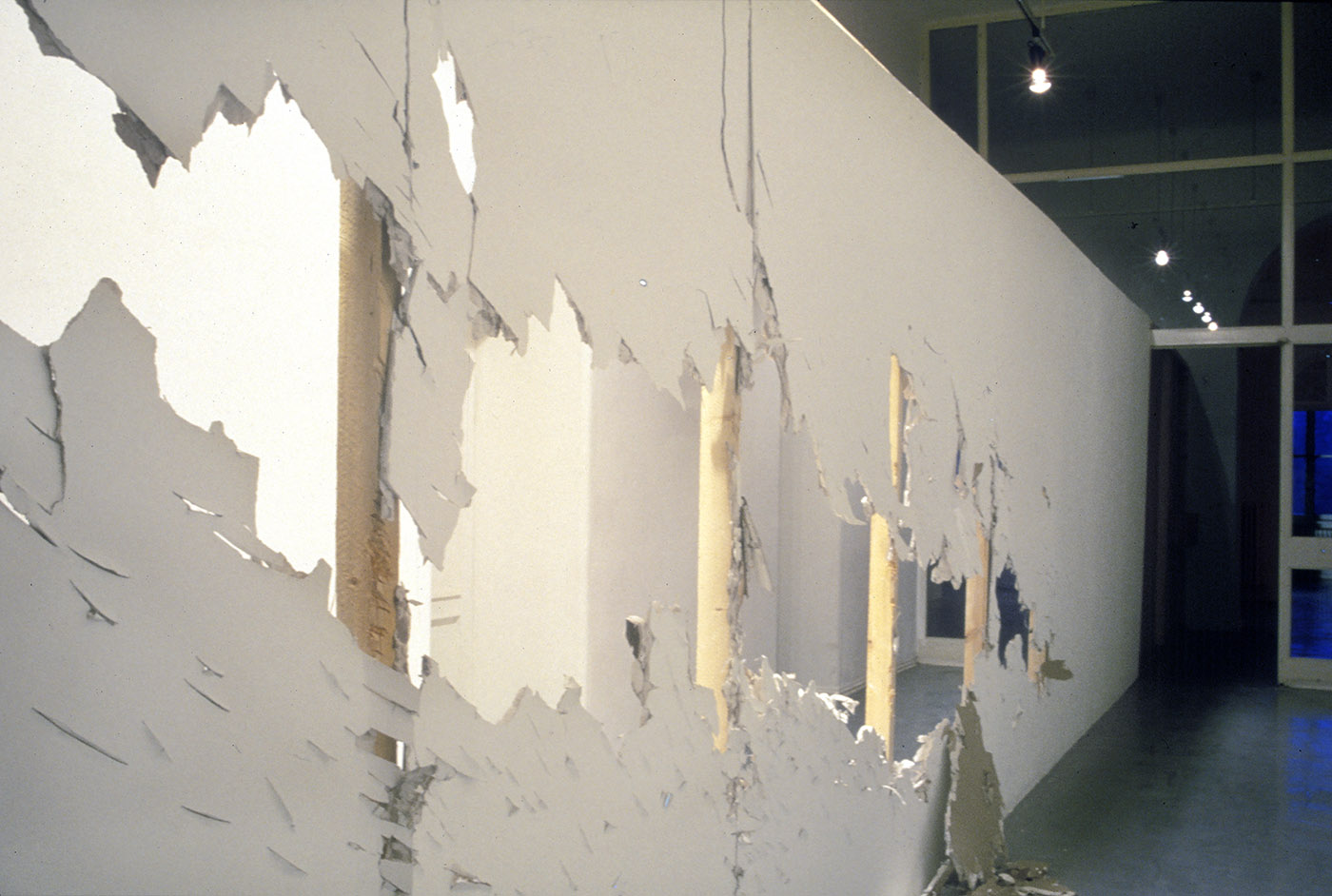
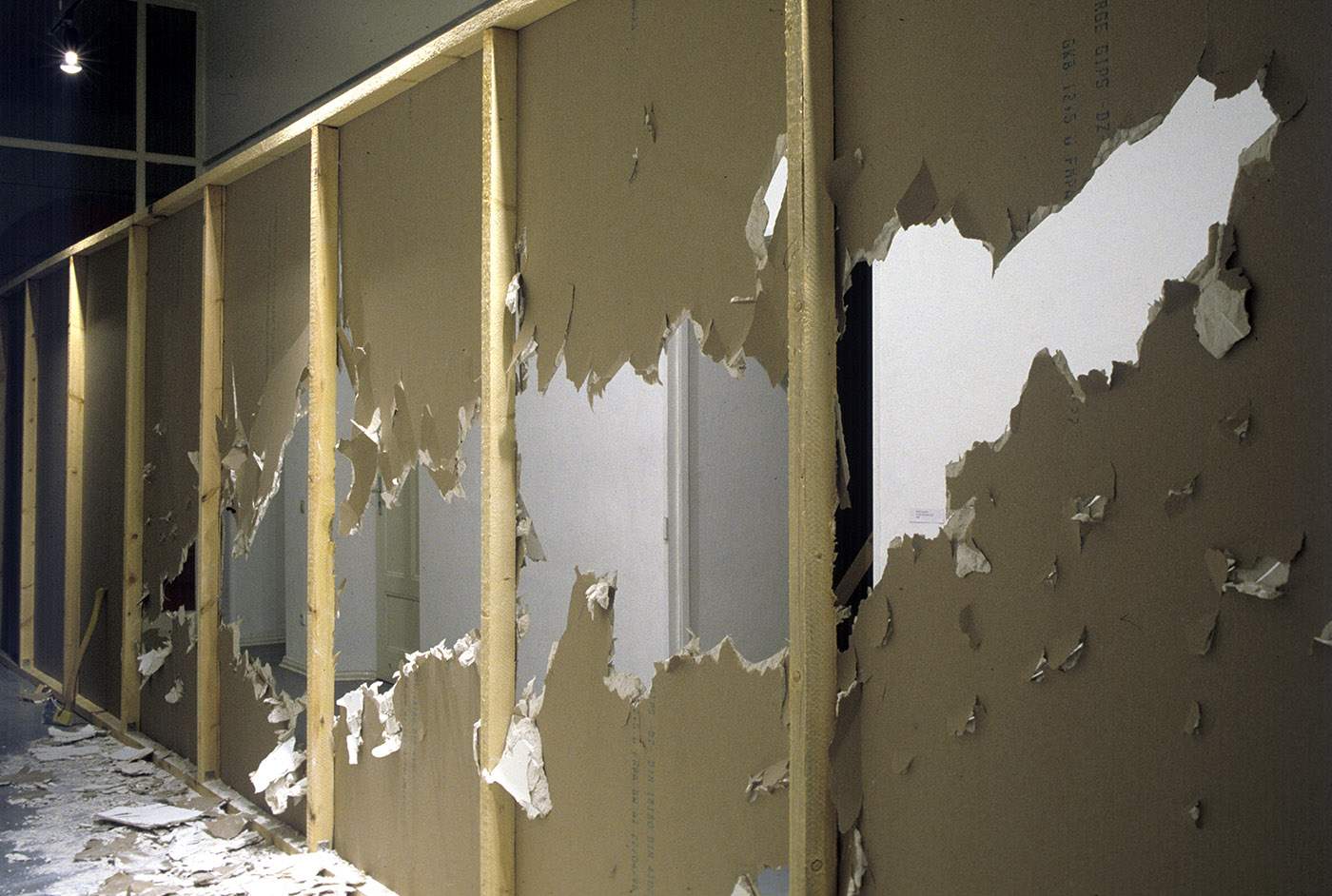
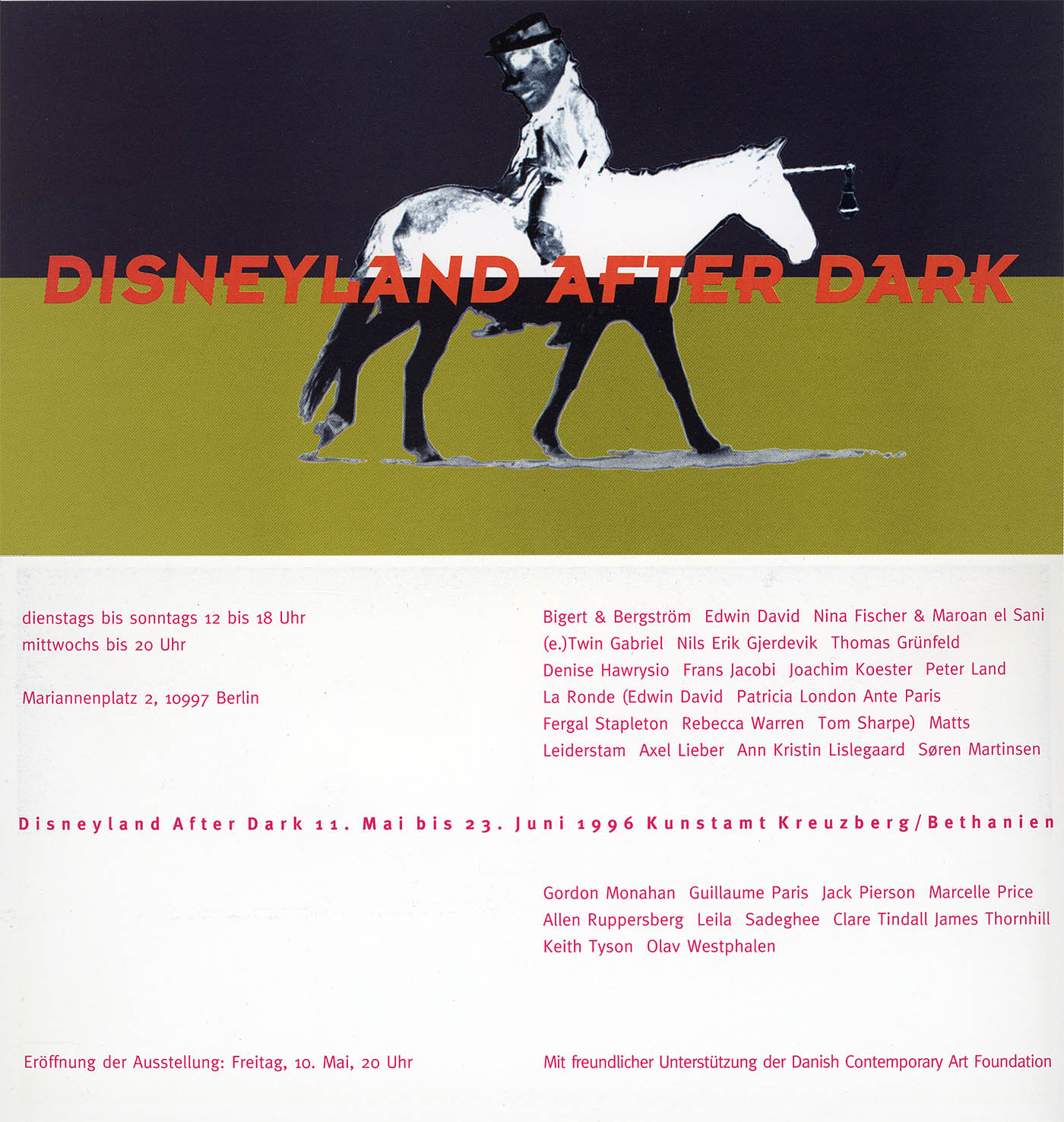
Disneyland After Dark catalogue
PRESS
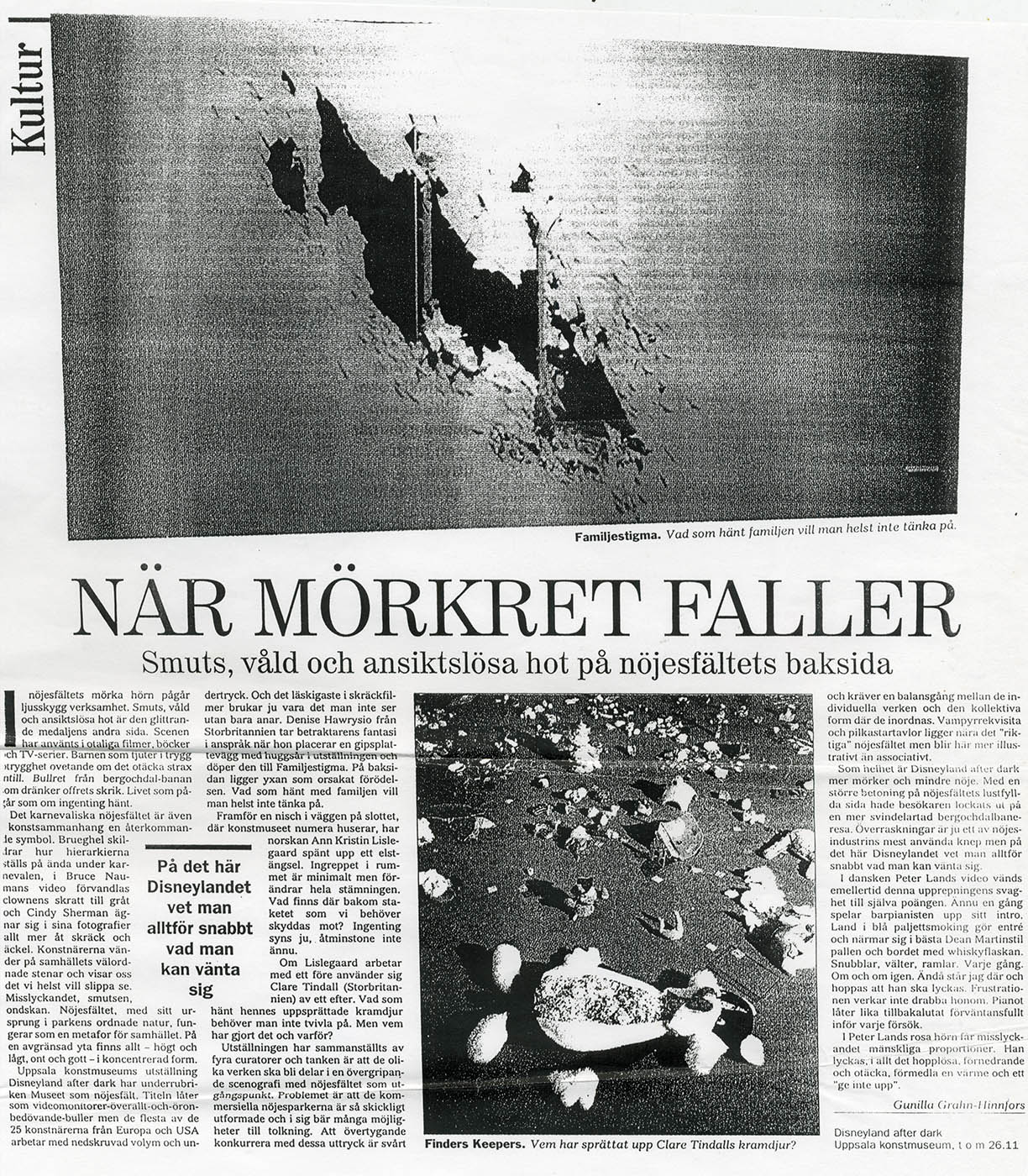
Uppsala Nya Tidning
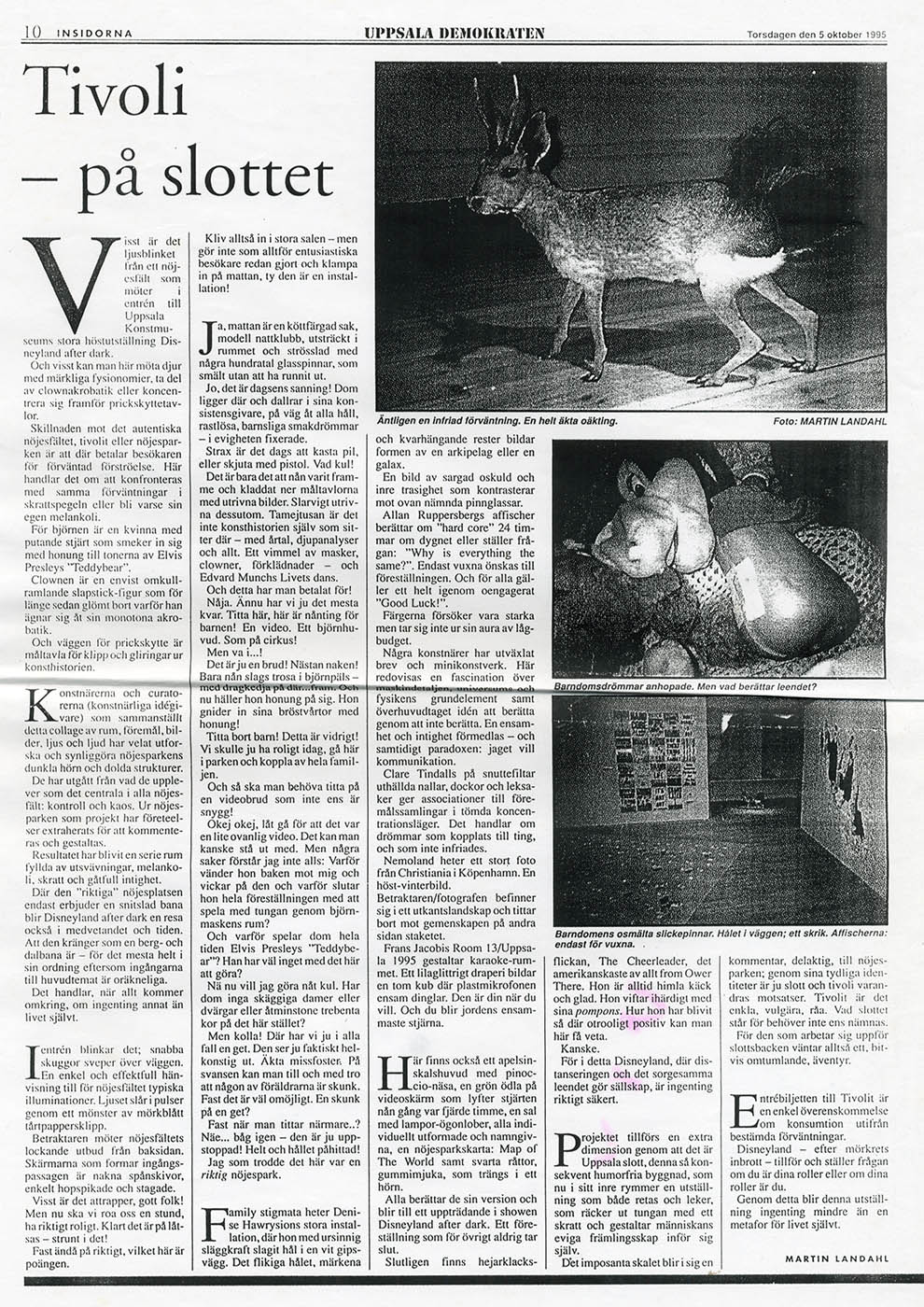
Uppsala Demokraten
Aftonbladet
Aftonbladet
Berlin review
When Darkness Falls
In the dark corners of the amusement park, shady activities take place. Dirt, violence and faceless threats are the other side of the glittering coin. Scenes from countless films, books and TV series have taught us that. Children who enjoy themselves in safe security are unaware of the looming threat just around the corner. The noise from the roller coaster drowns out the victim’s screams. Life proceeds as if nothing has happened.
The carnival-like amusement park is also a symbol in art history. Bruegel portrayed how hierarchies were turned upside down during the carnival. In Bruce Nauman’s video, the clown’s laughter turns to tears, and Cindy Sherman’s photographs show that fear and disgust are never far away. The artists chosen for the exhibition at Uppsala Art Museum show us stones and point out dirt that we would rather avoid. Failure, filth, evil. The amusement park, with its origins in the orderly world of nature, functions as a metaphor for society. At its worst and at its best — in a concentrated form.
The exhibition at Uppsala Art Museum is titled Disneyland After Dark. Here, video monitors, light and sound displays — the latter with reduced volume and under-pressure — prevail. And the most frightening, in its horror-film-like impression, is often that which is only hinted at. Denise Hawrysio from Great Britain engages the viewer’s imagination when she places a plasterboard wall with gash-wounds in the exhibition and names it Familjestigma (Family Stigma). On the back lies the axe that caused the devastation. What has happened to the family, one would rather not think about.
Opposite a niche in the wall of the castle where the museum is now housed, the Norwegian artist Ann Kristin Lislegaard has stretched out an elkskin. The intervention in the room is minimal, but changes the entire atmosphere. What is hidden there behind the elk hide? Something we need protection against? Nothing is visible, at least not yet.
If Lislegaard uses four curators, the idea is that the various works will be parts of an overarching set design with the amusement park as a starting point. The problem is that these commercial amusement parks are so skillfully designed and in themselves offer so many opportunities for interpretation. To convincingly compete with these expressions is difficult and requires a balancing act between the individual works and the collective form they are arranged in. The vampire props and dartboards lie close to the “real” amusement park, but become more illustrative than associative. As a whole, Disneyland After Dark is more darkness and less fun. With a greater emphasis on the seductive side of the amusement park, the visitors could have been lured out on a more dizzying roller coaster ride. Surprises are one of the most frequently used tricks of the amusement industry, but at this Disneyland, one knows all too quickly what to expect.
In the Danish artist Peter Land’s video, the repetition of the failing point is brought home once again. In a blue sequined tuxedo, he enters the stage and approaches the piano to play his intro. He slips, falls, and crashes. Every single time. Over and over again. Every time, one hopes he will succeed. Frustration seems not to affect him. The piano sounds like a return to the expectant moment before the failed attempt. In Peter Land’s rosy corner, failure has human proportions. He succeeds, in the midst of the hopeless. Formidable and touching, conveying a warmth and a “never give up” attitude.
Tivoli — på slottet
Certainly it is the neon glow from an amusement park, a tivoli or an entertainment field that meets you in the entrance to Uppsala Art Museum’s major autumn exhibition Disneyland after Dark. And certainly one can meet animals with strange physiognomies here, partake in clown acrobatics, or concentrate in front of target-shooting walls.
The difference between the authentic amusement park, tivoli, or entertainment field is that here you don’t pay the admission fee for expected amusement. Here, it is about being confronted with the same expectations in a funhouse mirror, or becoming aware of one’s own melancholy. For the bear is a woman with a protruding tail who smears herself with honey to the tones of Elvis Presley’s “Teddy Bear.” The clown is an awkwardly tumbling slapstick figure who seems to have long since forgotten why he is dedicating himself to his monotonous acrobatics. And the wall for target shooting is painted with clips and snippets from art history.
The artists and curators — the artistically responsible — who have assembled this collage of space, objects, images, light, and sound have wanted to explore and make visible the amusement park’s dark corners and hidden structures. They have started from what seems central to all amusement parks: control and chaos. From the amusement park as a project, phenomena have been extracted to be commented upon and gestated. The result has become a series of rooms filled with deviations, melancholy, laughter, and insightful madness. Where the “real” amusement park only offers a glossy surface, Disneyland after Dark travels an extra round in consciousness and time. That they are cramming in a roller coaster is mostly in order — the calculations after the entrances to the main themes are countless. It is about, when everything comes down to it, nothing less than life itself.
At the entrance it flashes; rapid shadows sweep across the wall. A simple and effective hint of the amusement park’s typical illuminations. The light strikes in pulses through a pattern of dark blue cake-paper cutouts. The viewer meets the amusement park’s alluring offerings from the backside. The screens forming the entrance passage are naked chipboard, simply nailed together and braced. Certainly they are props, folks! But now we shall enjoy ourselves, have a real laugh. Sure it’s make-believe — who cares! But still for real, which is the point.
Step right into the large hall — but do not do as all too enthusiastic visitors have already done and trample around on the carpet, because it is an installation! Yes, the carpet is a flesh-dyed thing, nightclub-style, stretched across the room and littered with a few hundred popsicle sticks that have melted without having run out. Yes, it is the truth of daytime! They lie there and quiver in their consistency, on their way to dissolving — restless, childish sweet dreams, fixed in eternity. Soon it is time to throw arrows, or shoot with a pistol. What fun!
It is just that someone has been there before and smeared the target walls with grim images. Sloppy presentation, furthermore. Dammit, isn’t it art history itself sitting there — with broad, deep analyses and all. A swarm of masks, clowns, aprons — and Edvard Munch’s The Scream. And this is what people have paid for! Well. Yet we have most of it left! Look here, look here — here is something for the children! A video. A bear head. Like at the circus! But what on earth…! It’s a bear! Almost naked! Only some kind of panties in bear fur — with a zipper at the… front. And now she pours honey on herself. Honey! She rubs her breasts and stomach with honey! Look away, child! This is vile! We were going to have a fun day out, walk in the park and bring the whole family. And then to have to watch a video that isn’t even beautiful! Okay, okay, let it go for being a bit unusual. One can perhaps endure it. But some things you don’t understand at all: why does she turn her backside to me and wag it, and why does she finish the performance by sticking her tongue through the bear mask’s mouth? And why on earth does Elvis Presley’s “Teddy Bear” play the whole time? What does he have to do with this? Now I want to do something fun. Aren’t there any bearded ladies or dwarfs or at least three-legged cows in this place? But look! There is actually a peculiar one. The pig is oddly designed. On the tail one can even see that someone from the parents is a skunk. Surely that’s impossible. A skunk on a goat? But when you step closer…? No… look again — it is stuffed! Fully and completely made up! Who thought this was a real amusement park?
Family Stigmata is the name of Denise Hawrysio’s large installation, which with its primal force has struck a hole in a white plaster wall. The flickering holes, the darkened and lingering remains form the shape of an archipelago or a galaxy. An image of battered innocence and tatteredness that contrasts with the previously mentioned popsicle sticks. Allan Ruppersberg’s posters tell of “hard core” 24 hours a day, or pose the question: “Why is everything the same?” Only adults are welcome to the performance. And for all that, a completely unengaged “Good Luck!” The colours try to be strong but do not rid themselves of their aura of low-budget. Some artists have exchanged letters and miniature works. Here is presented a fascination with machinery parts, the universe, and the fundamental elements of physics — and above all the idea of telling by not telling. A loneliness and intimacy is communicated — and at the same time the paradox: the self in communication. Clare Tindall’s soft toy blankets, dolls, and toy bears give associations to the emptied collection points of concentration camps. It is about dreams that were coupled to things, and which were not fulfilled. Nemoland is the name of a large photograph from Christiania in Copenhagen. An autumn-winter image. The viewer/photographer finds themselves in an edge landscape and looks away from the community on the other side of the fence. Frans Jacobi’s Room 13/Uppsala 1995 shapes a karaoke room. With a glittery fabric drapery, a blank cube where a plastic microphone hangs lonely. It is yours when you want. And you become the loneliest star on earth.
Here too is an orange-peel head with a Pinocchio nose, a green lizard on a video screen lifting its tail every fourth hour, a hall with lamp-eye globes — all individually designed and named — and an amusement park map: Map of The World, with black rats, rubber-soft, squeezed into a corner. All tell of their version and contribute to an emerging show in the Disneyland after Dark vein. An exhibition that leaves very little to the imagination. Finally, there is the heart-stoppingly cheerful — though this dimension is for adults only. The girl, The Cheerleader, the most American of all from Over There. She is always so terribly chipper and happy. She waves persistently with her pompoms. How she has become so incredibly positive — one can perhaps get to know here. Perhaps. For in this Disneyland, where the dancing smile and the sorrowful smile go hand in hand, nothing is really safe.
The project is given an extra dimension by its being set in Uppsala Castle — this consistently humourless building, which now in its interior accommodates an exhibition that both teases and plays, that sticks out its tongue with a laugh and holds up a mirror to humanity’s eternal alienation from itself. The imposing shell becomes complicit commentary on the amusement park; through their clear identities, castle and tivoli are each other’s opposites. Tivoli is the simple, vulgar, raw. What the castle stands for needs no mention. For those who work their way up the castle hill, a slightly disorienting adventure thus awaits. The admission ticket to the Tivoli is a simple agreement about consumption based on specific expectations. Disneyland after Dark breaks in — and poses the question of whether you are in your roles, or whether your roles are you. Through this blur, this exhibition becomes nothing less than a metaphor for life itself.
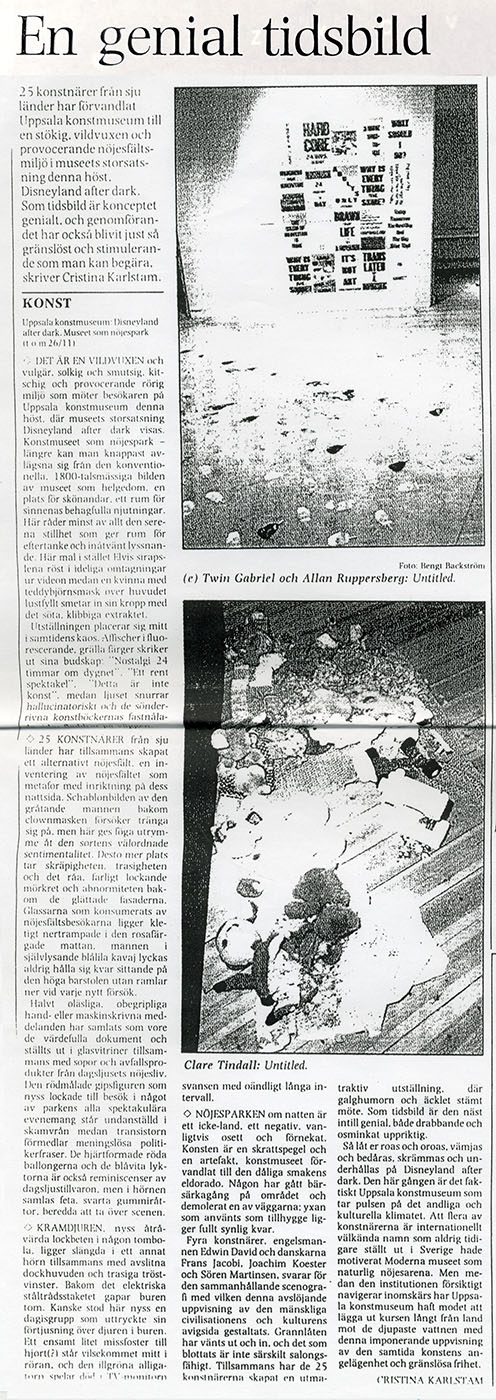
A Brilliant Image of Our Time
25 artists from seven countries have transformed Uppsala Art Museum into a messy, overgrown, and provocative amusement park environment in the museum’s major production this autumn, Disneyland after Dark. As an image of our time, the concept is brilliant, and the execution has also become just as boundary-breaking and stimulating as one could wish for.
It is a wildly-grown and vulgar, sun-soiled and dirty, kitschy and provocative messy environment that meets the visitor at Uppsala Art Museum this autumn, where the museum’s major production Disneyland after Dark is being shown. The art museum as an amusement park — one can no longer recognise anything of the conventional, 19th-century image of the museum as a temple, a place for beautiful thoughts, a room for the pleasant pleasures of the senses. Here, there is a total lack of the serenity that provides room for reflection and inward listening. Instead, Elvis’s syrup-sweet voice blares in constant replays from the video where a woman with a teddy bear mask over her head lustfully smears her body with the sweet, sticky extract.
The exhibition places itself in the chaos of the present. Posters in fluorescent, garish colours scream out their messages: “Nostalgia 24 hours a day.” “A pure spectacle.” “This is not art,” while the light spins hallucinatory and the torn-out pages of art books are fixed to the wall with infinitely long intervals.
The amusement park at night is a non-land, a negative, naturally overlooked and denied. Art is a funhouse mirror and an artefact; the museum has been transformed into an eldorado of bad taste. Someone has gone on a rampage in the area and demolished one of the walls; the axe used as an improvised weapon remains fully visible.
Four artists — Englishman Edwin David and Danes Frans Jacobi, Joachim Koester, and Søren Martinsen — are responsible for the coherent scenography with which this revealing exhibition of human civilisation and the backside of culture is depicted. The glitz has been turned inside out, and that which is exposed is not particularly salon-worthy. Together, the 25 artists have created an attractive exhibition where gallows humour and disgust meet. As an image of our time, it is almost genius, both poignant and unmaskingly honest.
It allows one to be amused and worried, disgusted and charmed, frightened and entertained at Disneyland after Dark. This time, Uppsala Art Museum has actually felt the pulse of the spiritual and cultural climate. That several of the artists are internationally well-known names who have never before exhibited in Sweden has motivated the Moderna Museet to naturally act as a partner. But while that institution cautiously navigates inshore, Uppsala Art Museum has had the courage to venture far out into the deepest waters with this impressive display of the contemporary artist’s predicament and limitless freedom.
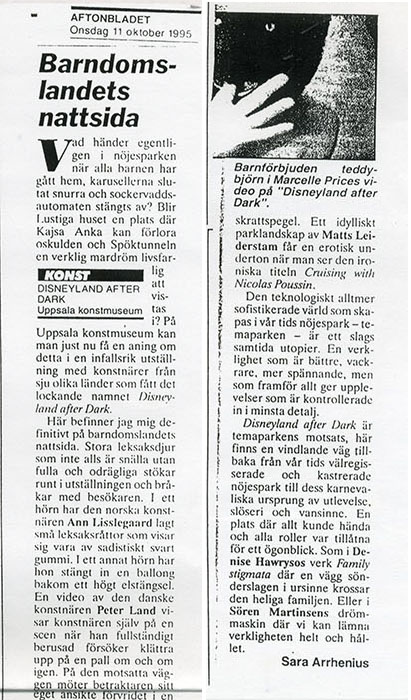
The Night Side of Childhood Land
What actually happens in the amusement park when all the children have gone home, the carousels have stopped turning, and the candyfloss machine is switched off? Does the Fun House become a place where Daisy Duck can lose her innocence and the Ghost Train a real nightmare of a life-path?
At Uppsala Art Museum, one can now get a sense of this in an imaginative exhibition with artists from seven different countries who have been given the alluring title Disneyland after Dark.
Here, I find myself definitively on the night side of childhood land. Large soft toys that are not at all kind spread out and unpleasantly mess about in the exhibition and brawl with visitors. In a corner, the Norwegian artist Ann Lislegaard has placed small toy rats that show themselves to be of sadistic black rubber. In another corner, she has locked in a balloon behind a high wire fence.
A video by the Danish artist Peter Land shows the artist himself in a scene where he, completely intoxicated, attempts to climb up onto a stool over and over again. On the opposite wall, the viewer is met by their own face distorted in a funhouse mirror. An idyllic park landscape by Matts Leiderstam reveals an erotic underside when one sees it under the ironic title Cruising with Nicolas Poussin.
The technologically increasingly sophisticated world that is created in the amusement parks of our time is a kind of contemporary utopia. A reality that is better, more beautiful, more exciting, but above all provides experiences that are controlled down to the smallest detail.
Disneyland after Dark is the antithesis of the theme park; through its winding path back to the origins of the well-regulated and castrated amusement park — its carnival-like roots of experience, waste, and madness. A place where anything could happen and all roles were permitted for a moment. As in Denise Hawrysio’s work Family Stigmata, where a wall is smashed in a frantic cross-section through the holy family. Or in Søren Martinsen’s dream machine, where we can leave reality entirely.
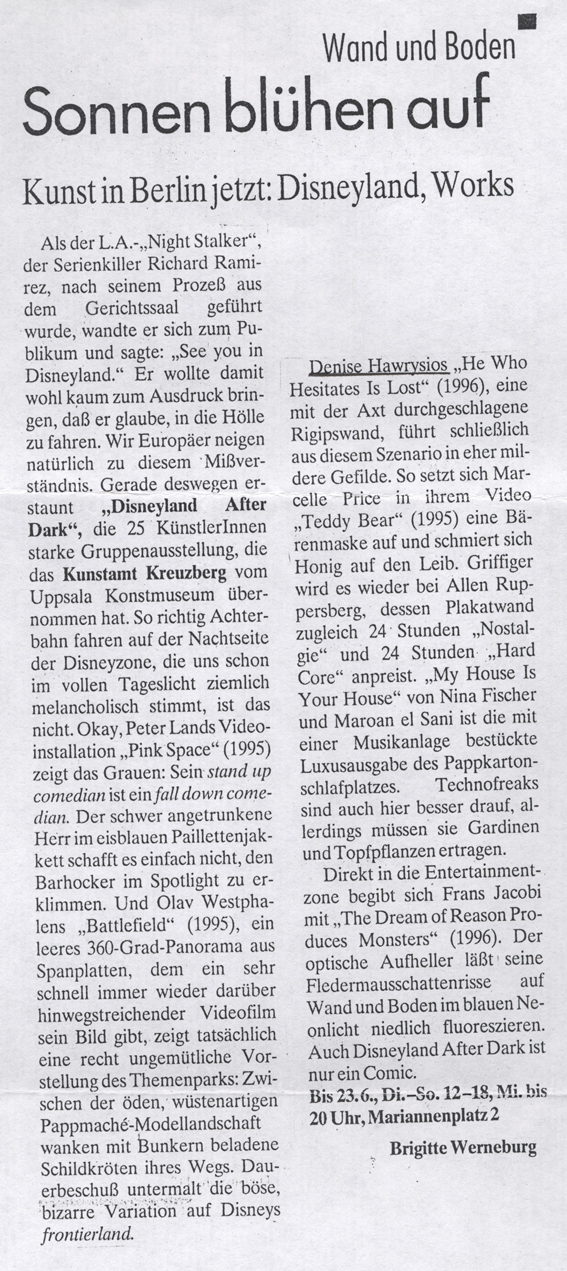
Art in Berlin Now: Disneyland, Works
When the L.A. “Night Stalker,” serial killer Richard Ramirez, was led out of the courtroom after his trial, he turned to the audience and said: “See you in Disneyland.” He hardly intended to express a belief that he was going to hell. We Europeans, of course, are prone to this misunderstanding. Precisely for that reason, Disneyland After Dark — the 25-artist-strong group exhibition that the Kunstamt Kreuzberg has taken over from the Uppsala Art Museum — is so surprising. This isn’t exactly a roller coaster ride on the night side of the Disney Zone, which already makes us feel quite melancholic in broad daylight.
Okay, Peter Land’s video installation Pink Space (1995) shows the horror: his stand-up comedian is a fall-down comedian. The heavily intoxicated gentleman in the ice-blue sequined jacket simply fails to climb the bar stool in the spotlight. And Olav Westphalen’s Battlefield (1995), an empty 360-degree panorama made of chipboard — given its image by a video film sweeping over it again and again at high speed — actually shows a rather uncomfortable vision of the theme park: between the desolate, desert-like papier-mâché model landscape, turtles laden with bunkers stagger on their way. Constant shelling underscores this wicked, bizarre variation on Disney’s Frontierland.
Denise Hawrysio’s He Who Hesitates Is Lost (1996), a plasterboard wall smashed through with an axe, finally leads out of this scenario into rather milder climes. Similarly, Marcelle Price in her video Teddy Bear (1995) puts on a bear mask and smears honey on her body. Things get more tangible again with Allen Ruppersberg, whose billboard simultaneously advertises 24 hours of “Nostalgia” and 24 hours of “Hardcore.” My House Is Your House by Nina Fischer and Maroan el Sani is a luxury version of a cardboard sleeping place equipped with a music system. Techno-freaks are in a better mood here, though they must endure curtains and potted plants.
Frans Jacobi heads straight into the entertainment zone with The Dream of Reason Produces Monsters (1996). The optical brightener makes his bat silhouettes fluoresce cutely on the wall and floor in the blue neon light. Disneyland After Dark is also just a comic.