Etching Plate as Shield
- An Etching Plate Feels No Pain, SNAP, Edmonton, 2011
- Situational Prints, Open Studio, Toronto, 2009
Denise Hawrysio’s Etching Plate as Shield explores the boundaries between conceptual art, physical performance, and the printmaking process. This series was developed in response to a climate of heightened anxiety and media narratives surrounding crime in socially deprived areas of London, including her own neighbourhood of Peckham.
Each work in the series juxtaposes an abstract etching with an identically sized photograph of the artist navigating mundane public settings — such as queuing at a shop counter or walking down a busy street. In the photographs, Hawrysio is seen wearing a dark, rectangular copper etching plate on her torso, functioning as a literal and symbolic protective shield.
The project challenges the viewer to decode the relationship between the raw reality of the city and the abstracted marks on the plate. While the photographs directly reference conceptual artist Adrian Piper’s Catalysis III (1970), the etchings themselves remain purely indexical, bearing the physical evidence of their rough handling during these public walks.
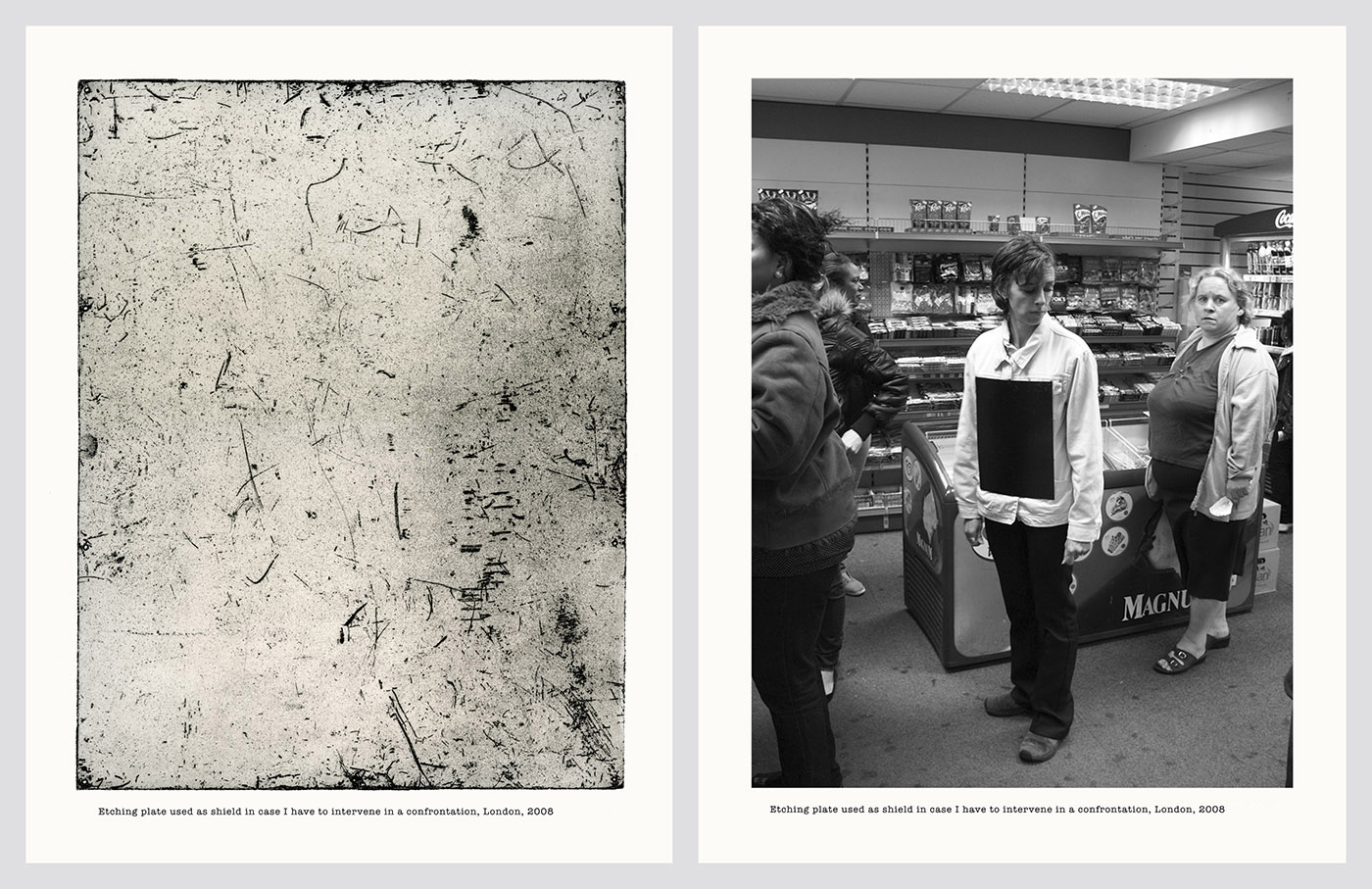
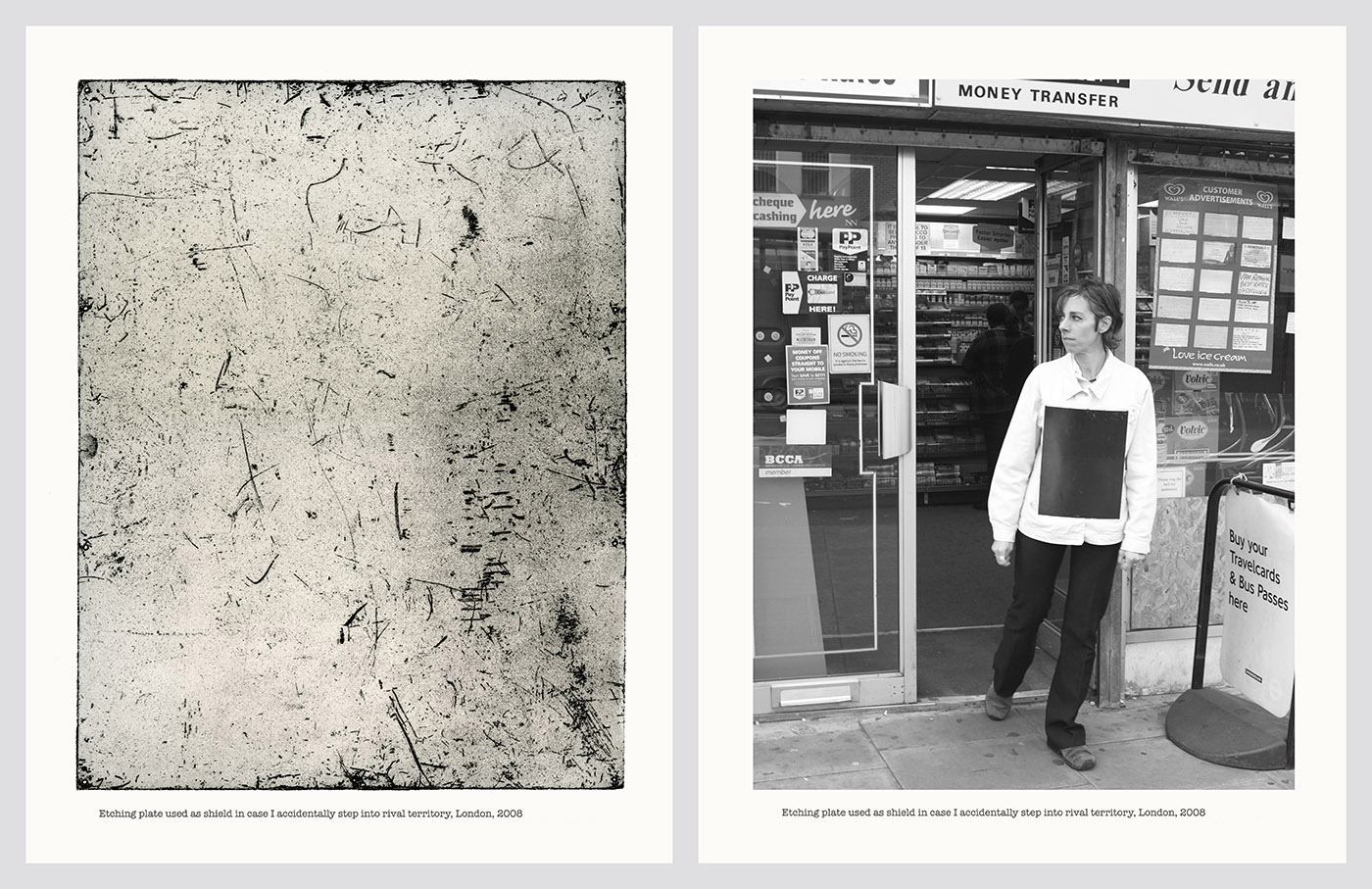
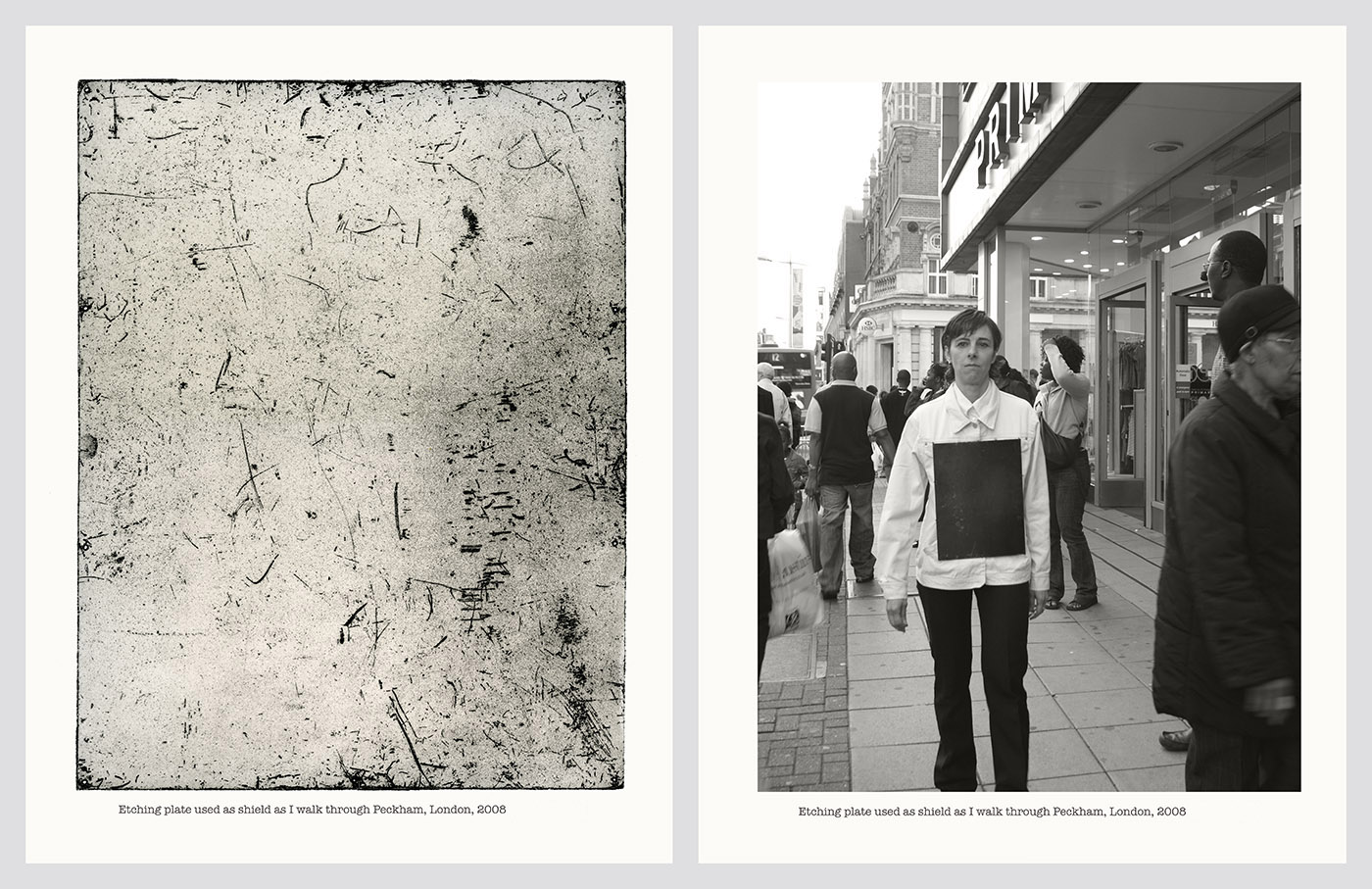
In April 2008, the British newspapers were lapping up a publicity photograph of Harriet Harman, Deputy Leader of the Labour Party, touring her socially deprived South London constituency of Peckham wearing a stab-proof jacket. Amidst a spate of teenage knifings in London, Harman’s photo op alongside neighbourhood officers in their ‘stab-vests,’ seemed both an unconscious admission of policy failure, and a misguided gimmick which placed the politician beyond the lives of the people she represented, who, after all, went about Peckham in broad daylight without the benefit of body armour. I was reminded of Harman’s PR gaffe when I saw Denise Hawrysio’s series of works Etching Plate Used as Shield, respectively followed by the clauses: as I walk through Peckham; as I accidentally step into rival territory; and in case I have to intervene in a confrontation. Each title is printed once below an etching, and a second time below a juxtaposed, identically sized photograph of the artist in a mundane public setting: walking down a high street, or queuing at a newsagent’s counter; in each shot a dark rectangular plate partially covers her torso. The incongruity of Hawrysio’s protective attire pulls together, and comically deflates, the fear-mongering media hysteria about crime, and the heroic, or socially conscious artist’s imperative to be ‘in the thick of it,’ located where the real action is. This ‘reality’ is vouched for through the medium of photography — yes, Hawrysio was really there. But in the bare abstract marks of the juxtaposed etchings, we have a yet more viscerally direct relation to the real.
A metaphorical violence runs throughout Hawrysio’s prints through an analogy with the process of etching, one that involves exposure and abrasion. It was the mental after-effects of trauma that lead Freud to speculate, in Beyond the Pleasure Principle, about the origins of organic life and their instructive value for thinking about a defensive psychological anatomy: a ‘vesicle’ (all surface), a ‘little fragment of living substance suspended in the middle of an external world charged with the most powerful energies…would be killed by stimulation if it were not provided with a protective shield against stimuli.’ As anyone who lives in London knows, it’s not a good idea to leave home without at least putting on your psychological body armour. — Dean Kenning, An Etching Plate Feels No Pain
Press